


Transforming Stroke Recovery
Contralaterally Controlled Function Electrical Stimulation (CCFES): Empower your patients to regain wrist and hand function through innovative, patient-driven therapy.
Why Choose Synchrony® for Your Practice?
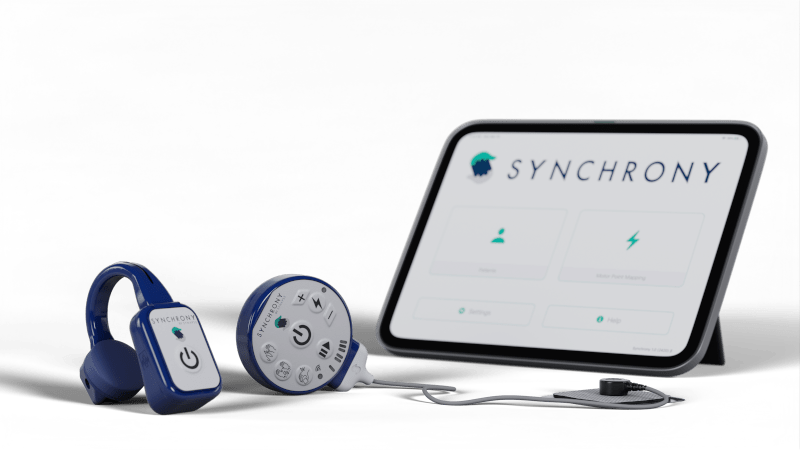
Synchrony® is a novel application of functional electrical stimulation that capitalizes on bilateral motor pathways to promote wrist and hand recovery after stroke via Contralaterally Controlled FES (CCFES). CCFES has been consistently found superior to conventional NMES in recovering hand dexterity in both acute and chronic stages after stroke.
Synchrony® can be easily utilized within therapy sessions and go home with the patient, which allows for high-dose, high-repetition treatment as recommended in the Stroke Clinical Practice Guidelines. The device is simple to set-up, with light-weight equipment that can be donned with one hand while allowing for unimpeded mobility.
Synchrony® is intended for use in adult patients (22 years and older) whose paralysis or paresis is caused by upper motor neuron injury (e.g., stroke, spinal cord injury, etc.) by prescription use only.
Modes of Therapy
CCFES
Contralaterally Controlled Functional Electrical Stimulation (CCFES) is an exercise for improving hand movement in patients who have hand weakness or paralysis on only one side. CCFES is intended to help open the hand, and assumes the patient has some ability to close the hand. CCFES electrically stimulates the affected or paralyzed muscles that open the fingers and thumb with electrode pads that stick to the skin on the upper surface of the forearm.
With CCFES, stimulation to the affected hand is controlled by the Synchrony Sensor on the opposite (contralateral) unaffected hand. When the patient opens his or her strong hand wearing the sensor, a corresponding amount of stimulation opens their affected or paralyzed hand. The sensor lets the patient control how wide their affected hand opens. A full opening would deliver 100% of programmed stimulation to the affected hand and a closed hand would reduce stimulation to zero.
When using CCFES, patients should be instructed to try to open both hands at the same time. Doing so will make the stimulation occur at the same time as their effort to open their affected hand. In this way, CCFES “rewards” the brain with achieving hand opening when the patient tries to open the affected hand. Rewarding the brain repetitively like this may produce changes in the brain that result in greater recovery of hand movement.
CCFES can be programmed as exercise or therapy. For exercise, the patient performs set/s of repetitive cues to open and relax hands. For Therapy, the patient performs functional task practice with the use of the Synchrony Sensor to regulate and control affected hand to perform task practice movements that are given by the therapist.
Cyclic
Cyclical Exercise mode uses one to four channels to activate the wrist and/or finger and thumb extensors/flexors in a repetitive (cyclic) fashion via surface electrodes placed on the forearm over the motor points of those muscles. Once the device is set up and switched on, the stimulation automatically ramps on and off according to a selected duty cycle, with the patient not having to exert any simultaneous effort. This mode can be used as a warmup or exercise to build strength in the patient’s forearm.
Functional Task Practice
FTP mode is intended to facilitate functional task practice. Arrow increase and decrease buttons allow the therapist to modulate the hand movement by increasing and decreasing stimulation by 5% increments. Therapists can also wear the Synchrony Sensor to modulate stimulation and control the patient’s hand movement.
Research Supports CCFES
20 Years of NIH-funded clinical trials
-
- Significant improvements reported in Fugl-Meyer scores and ROM measures in multiple meta-analyses
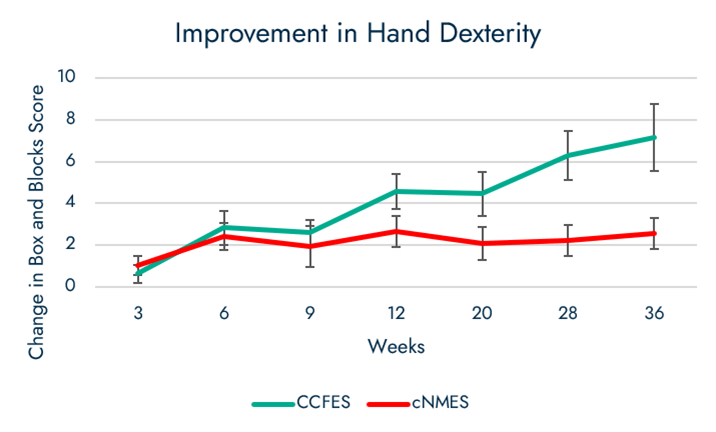
- Improvements exceed MDC in Box and Blocks final scores over cNMES users
Incorporation of task practice alongside patient-driven, bilaterally synchronized movement may explain why greater functional changes are seen with CCFES over conventional NMES.
More research can be found in ourBibliography